How I Turned My Program Curriculum Into 100 Content Ideas
Jun 30, 2026
QUICK OVERVIEW
How can I use AI to turn my expertise into content ideas?
Put your handouts, transcripts, and presentations in one place. Then have Claude inventory them and build a content plan.
In this post, you'll learn:
- Why content without a compass keeps you scrambling
- How to gather your work into one knowledge base
- The two prompts that turned my curriculum into 100 content ideas
- The one rule that keeps free content pointing to your offers
This one’s for the practitioner who’s been in practice long enough to have built up a unique base of knowledge. Maybe you’ve turned it into a course or a program, but not necessarily.
Maybe it lives in podcast interviews scattered across the internet.
Maybe it lives in the slide decks and notes you’ve made for talks and presentations.
Maybe it lives in dozens of patient handouts saved on your computer.
And yet…
Every week, you scramble to come up with new ideas for blog articles, newsletters, and social posts.
It’s a waste of time and energy, but that’s not even the biggest cost.
When your content has no compass, when it leans on whatever inspiration happens to strike that week, you miss the chance to move people from curiously lurking to confirmed clients.
If you’ve ever thought, What if AI could just pull my content ideas straight from the knowledge base I’ve already built, so I didn’t have to worry about it every week?
That’s exactly what you’re about to set up.
By the end of this article, you’ll have a process to turn your existing body of work into a reusable bank of content ideas that naturally warms people up to your offers.
The context
I recently finished updating the curriculum inside my program, Aligned. When it was done, I realized I was sitting on months of content ideas. I just needed a way to pull them out without rereading everything every week.
That's what led to the process below.
The process
Step 1. Gather your knowledge base
This is the step that takes the most time and is most likely the reason you’ll never do it.
So here’s an idea: What if you don’t do this part yourself?
Gathering your knowledge base does not require your expertise because the knowledge already exists. So hand this step over to an assistant and let it start working without you.
Here’s what you (or your assistant) will do:
Dig up every place where your clinical knowledge and expertise are written down or recorded. Look for podcast interviews, blog articles, patient handouts, and presentations.
Then save it all to a single folder on your computer, ideally as Markdown files.
Step 2. Point your AI to it
The goal is to give AI access to every file in your knowledge base at once.
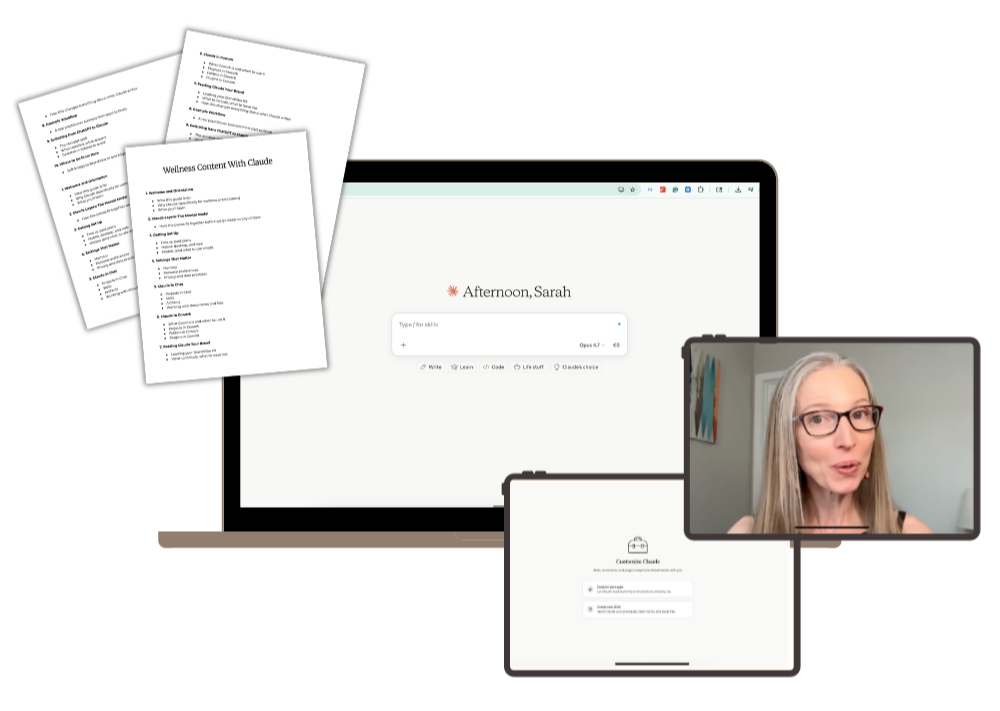
Between my video transcripts, copywriting templates, workbooks, and AI Specialists, I had more than 100 files. Too many to drop into a single chat, so I loaded them as Project files in Claude.
Note: This will not work in a ChatGPT Project because you will hit the upload limit.
I did this in Claude Chat (the browser version), not Cowork (the desktop version). But it would work equally well and may even be easier to do in Cowork because you could just point Cowork directly to that knowledge base folder on your computer and put it to work there.
Step 3. Ask for an inventory
This was the step that my mind was hung up on for the longest. I wanted my curriculum to be a source of inspiration for content ideas, but I didn’t want my AI to scan it all every week.
That’s just not efficient. Not systematic.
I also knew that with this much material, I wanted the AI to slow down and carefully review, understand, and organize it all before jumping into content ideas.
So I asked it to create an inventory.
Specifically, I asked it to write a detailed, organized description of everything in the knowledge base, and to frame each item around the value it offers my clients.
THE PROMPT
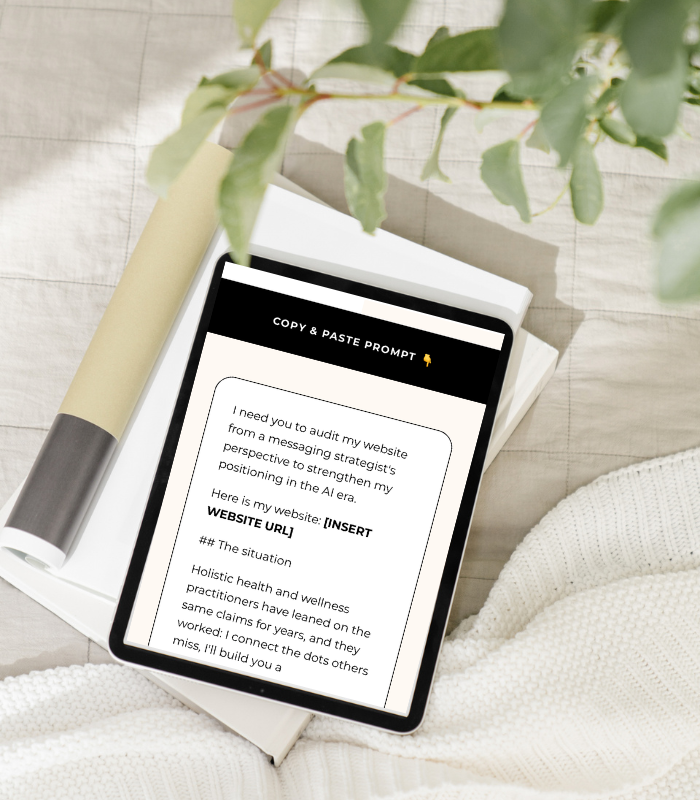
I’ve uploaded my full knowledge base as project files. This includes things like transcripts, articles, presentations, patient handouts, templates, and any other material where my expertise and experience show up. My ultimate goal is to use this base of knowledge as inspiration for blog posts, social media posts, and email newsletters. But before we do that, I want you to slow down and build a complete inventory of everything in this knowledge base. Go through every file and look for my core promise, what makes my thinking different, my signature frameworks, my credibility, the transformation my clients experience, and my unique teaching points. Organize this into a complete inventory with clear categories that make sense for this knowledge base. Don’t generate content ideas yet. I want this inventory to exist as a standalone reference first.
It’s pretty awesome what I got back.
Step 4. Ask for a content plan (with one caveat)
Once I had that inventory, I asked Claude to come up with five content pillars and at least twenty content ideas under each. That’s 100 ideas from one prompt.
But I gave it one important caveat.
These were strictly for my free content. So I told Claude to stick to ideas I’m glad to share publicly, nothing from behind the paywall. Not my actual frameworks. Not the actual AI tools. Not the project setups. Not the full system. Just the small tips and quick wins.
That caveat is what keeps your content ideas warming people up to your offers without handing everything over for free.
THE PROMPT
Using the inventory you just built, create a content plan for my free content only (things like social posts, newsletters, and blog articles). Give me 5 content pillars. Under each pillar, give me at least 20 specific content ideas drawn directly from the inventory. One important rule: these ideas are strictly for content I’m glad to give away for free. Do not include the details of proprietary frameworks, my internal tools or processes, or anything that represents the full system I teach or sell. Stick to small tips, single insights, mindset shifts, and quick wins that stand on their own. The goal is content that proves my expertise and warms people up, while keeping the full system and frameworks reserved for paying clients.
What you’ll get out of it at the end is a complete content plan with 100 topics drawn from YOUR knowledge base. Not from trends. Not from what everyone else is saying. From you.
That’s the magic.
Your next hundred ideas already exist
I’m all for creating from inspiration when the idea hits.
But inspiration doesn’t always show up on schedule. Not on the day the reel needs to post or the newsletter needs to go out.
A knowledge base like this means you can take a break.
You can let your AI take on some of the heavy lifting and free up your time and energy for the work only you can do.