Storytelling for Wellness Practitioners: How to Use Real Life to Create Content That Connects
Feb 09, 2026
Quick Overview:
Strategic storytelling for practitioners means using real-life moments to create marketing content that feels human and intentional.
In this post, we’ll cover:
- What strategic storytelling is (and what it isn’t)
- Why you don’t need to be outgoing or a natural storyteller to use it
- The 3-part strategic storytelling framework
- The most effective story types for wellness practitioners
- Simple prompts to use when you don’t know what to post
- Common storytelling mistakes that create confusion
- How to make storytelling a sustainable part of your content process
If you’ve ever told yourself:
“I’m just not a storyteller.”
“This feels awkward.”
“I don’t want to overshare.”
I’ve fully been there too.
It was always my boisterous cousins or outgoing friends who kept everyone entertained with their stories. Meanwhile, I was the quiet and introverted one.
Definitely not a natural storyteller.
But storytelling in marketing content is completely different.
You do not need to be:
✘ Naturally outgoing
✘ Funny
✘ Entertaining
✘Charismatic
✘ Or the center of attention
You don’t need any of that.
All you need are tiny moments from your real life.
Strategic storytelling is simply the intentional use of real moments to bring humanity into your marketing.
And it’s a muscle you can build through practice.
What Makes Storytelling Strategic
A story without direction is just a diary entry.
A strategic story creates movement.
Here’s an example of a non-strategic story:
“I was 20 minutes late this morning because I spilled coffee in my car and had to go home to change my pants. Anyone else having a Monday?”
Relatable? Yes.
But it’s also a dead end.
Now here’s how the same moment becomes strategic:
"I spilled coffee on my lap while driving to work.
A past version of me would’ve spiraled and replayed it all day.
But this time was different.
I’ve learned how to calm my nervous system when stressful things happen.
So yes, I was 20 minutes late—but I was calm, present, and able to serve my patients fully.
Want to train your body to be more resilient to stress?
Comment FREE for my nervous system reset guide."
The difference?
Storytelling becomes strategic when:
- There is a reason the story exists
- It supports a message, belief, or offer
- It moves the reader somewhere specific
A strategic story invites people into a reframe or teaching moment that naturally connects to how you help.
The Three-Part Strategic Storytelling Framework
Every strategic story needs three elements. Remove one, and the story stops working.
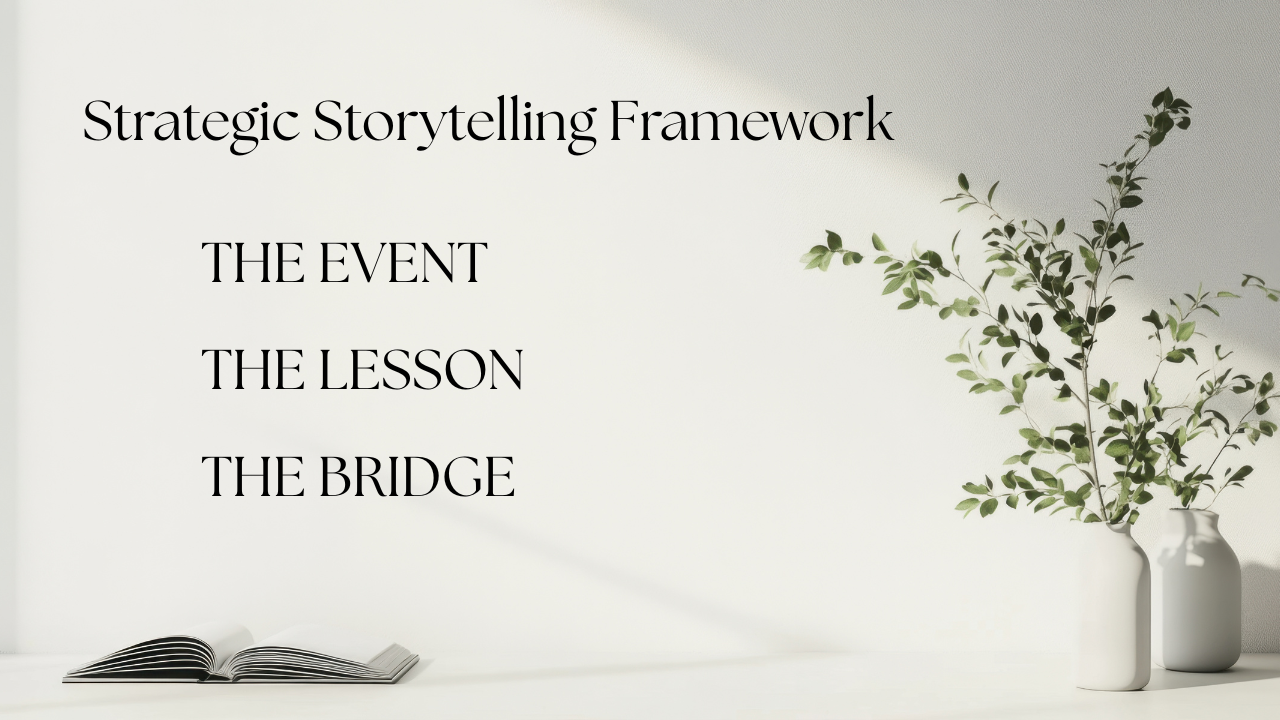
1. The Event
This is the anchor.
- An everyday moment
- A clinic-related observation
- A single sentence is enough
Ask yourself: What happened?
2. The Lesson
This is the meaning.
- One mindset shift
- One belief
- One clear takeaway
Ask: What’s the point?
3. The Bridge
This is where it becomes marketing without feeling salesy.
- A bridge to your offer
- A free resource
- How you help
This answers: How does this connect to my offers?
Strategic storytelling is not only more engaging to read. It also creates a more natural and compelling connection to your products or services.
The Main Types of Strategic Stories Practitioners Can Use
This isn’t a comprehensive list, but these are the story types that tend to move the needle the fastest in wellness marketing.
Offer-Specific Stories
Every offer needs a story.
- Why you created it
- What problem you kept seeing
- What wasn’t working anymore
For example, I created an offering called Posted! I noticed a seismic shift happening on social media. Copy-and-paste “3 tips for gut health” content simply wasn’t cutting it anymore.
Practitioners needed a simple way to bring more of themselves into their content (without burning out!). So I created Posted! and the minimum viable social media strategy for practitioners to fill that gap.
These offer-specific stories often turn into soundbites you return to again and again.
Your Origin Story
This isn’t one long “About Me” post. It’s moments from:
- A personal health shift
- A professional pivot
- A realization that changed how you work
Shared in moments. Over time.
For example, I’d been doing copywriting for over a decade when AI entered the scene and I realized it could handle about 80% of the work I was doing.
That moment led me to shift my entire focus toward helping practitioners leverage AI while bridging the remaining 20% (i.e., the human nuance that actually makes content work).
That’s a single moment.
And it explains the origin of my current work.
Everyday Moment Stories
This is where storytelling stops being a one-off and becomes second nature.
When you learn to weave everyday moments into your content, storytelling becomes something you naturally just do.
The next section gives you simple prompts to help with that.
Simple Story Prompts You Can Use Right Away
If staring at a blank page freezes you, start here.
These are examples of how everyday moments can become strategic stories.
- Time Collapse
“I’ve reviewed over 2000 lab reports, and here’s the most common pattern I see in women over 40.” - Borrowed Credibility
“I was reading a recent study in JAMA and here’s what I learned.” - Client Examples
“Here’s exactly what my client did to clear lifelong acne in just 3 months.” - Clinic or Community Moments
“This week I had 3 people come in with the same health issue.” - Everyday Life Moments
“Yesterday I went to the store for eggs and came home with 3 bundles of daisies.” - Trending Takes
“I’m hearing a lot of people talk about the diet that just hit the news.” - ‘How I’ Stories
“How I approach meal planning for my family as a holistic nutritionist with 4 allergic kids.”
These stories can act as hooks (the first sentence of a post, reel, or email) or as credibility and connection points just after the hook.
Where you place them matters far less than using them. Period.
They signal: “This information comes from a real human, not a bot.”
Common Storytelling Mistakes
If you overthink storytelling, you’re more likely to fall into one of these traps:
- Stories with no lesson or no bridge
- Oversharing without a point
- Vulnerability without transformation
- Posting before emotional processing
The simplest fix?
Return to the framework: event → lesson → bridge
And make sure anything you share (especially if it’s vulnerable) still positions you as a credible guide rather than a raw, unprocessed narrator.
How to Make Storytelling a Sustainable Habit
Storytelling doesn’t need to add anything to your workload. It just changes how you approach the work you’re already doing.
Here are a few simple ways to make it easy and repeatable:
- Keep a story bank
Notes app. Google Doc. One running list. - Weave one story sentence into what you’re already writing
A hook. An email opener. A caption intro. - Repurpose educational content
Same lesson. New story. - Use “I” more often
By simply changing "How to" to "How I," you're immediately shifting into storytelling
Don’t take it too seriously. Practice and you’ll naturally get better with time.
Before long, storytelling will feel second nature.
Strategic storytelling is simply letting your lived experience inform how you teach, guide, and invite people into your work.
When you do that, your content stops feeling forced and starts feeling like you.
FAQs about Storytelling for Wellness Practitioners
What is strategic storytelling in marketing?
Strategic storytelling is the intentional use of real-life moments to support a message, belief, or offer.
Instead of sharing stories just to be relatable, strategic storytelling creates clarity, builds trust, and guides your audience toward a specific insight or next step.
Do I need to be good at storytelling to use this approach?
No. You don’t need to be charismatic, entertaining, or naturally expressive. Strategic storytelling works best when it’s simple and grounded. One everyday moment, paired with a clear lesson and a bridge to how you help, is more effective than a dramatic or polished story. This is a skill you can practice and refine over time.
How is strategic storytelling different from oversharing?
Oversharing focuses on emotional release. Strategic storytelling focuses on meaning and transformation.If a story includes:
- a clear lesson
- a grounded takeaway
- and a connection to your work
…it builds trust and positions you as a guide.
If a story is shared before it’s processed or has no point, it often leaves the audience unsure how to relate or respond.
How long does a strategic story need to be?
It can be very short. A single sentence is often enough to anchor a strategic story—especially in social posts, email openers, or reels. What matters isn’t length, but structure:
- the event
- the lesson
- the bridge
Even micro-stories can be powerful when those elements are present.
What kinds of stories work best for wellness practitioners?
Some of the most effective story types include:
- moments from clinical or community observations
- patterns you notice over time with clients
- everyday life moments that mirror a health or mindset truth
- origin moments that explain why you work the way you do
These stories help your audience feel both seen and supported.
How often should I use storytelling in my content?
Storytelling doesn’t need to be reserved for special posts. Many practitioners find success by weaving one small story or moment into:
- a social post
- an email opener
- a blog introduction
- a sales page section
Over time, this becomes a habit rather than an extra task.
Can strategic storytelling help me sell without sounding salesy?
Absolutely. That’s one of its biggest benefits. When you naturally connect a story to how you help, the invitation feels contextual rather than pushy. You’re not convincing someone to buy. You’re helping them understand why your work exists and who it’s for. That clarity often leads to more aligned inquiries and easier sales conversations.